DSCR Loans in Colorado: Qualify a Rental on Its Rent, Not Your Tax Returns
A DSCR loan qualifies a rental property on the rent it produces rather than the income you document. Here is how the ratio is calculated, what Colorado lenders actually require, and where the structure helps or hurts.
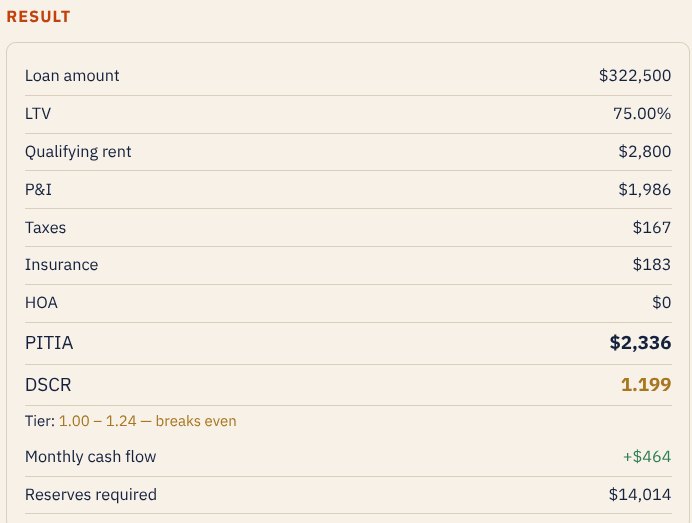
A DSCR loan qualifies a Colorado rental property on the rent it produces instead of the income you document — no tax returns, no debt-to-income ratio, and title can be held in an LLC. The lender divides qualifying rent by the full payment (principal, interest, taxes, insurance and HOA); a $2,800 rent against a $2,371 payment is a DSCR of 1.18. Expect 20% down minimum, a 620 minimum credit score, and a prepayment penalty priced into the rate.
The one thing that makes a DSCR loan different
On a conventional investment-property loan, you qualify. The lender reads your tax returns, calculates your debt-to-income ratio, and counts every other mortgage you carry against you. Buy enough rentals and that math eventually stops working, no matter how well the properties perform.
On a DSCR loan, the property qualifies. The lender divides the property's qualifying rent by its full monthly payment and looks at the resulting ratio. Your tax returns are never requested. Your DTI is never calculated. The rentals you already own do not count against this one.
How the ratio is calculated
DSCR is qualifying rent divided by PITIA — principal, interest, taxes, insurance and any HOA dues. Every piece of the payment is in the denominator, which is why taxes and insurance matter more on a DSCR file than borrowers expect.
A concrete case. A $400,000 rental with 25% down leaves a $300,000 loan. At 7.125% that is a $2,021 principal-and-interest payment. Add $200 a month of property tax and $150 of insurance and the PITIA is $2,371. If the property rents for $2,800:
$2,800 ÷ $2,371 = 1.18
That clears 1.00 comfortably and lands in the middle pricing tier.
Where the rent number comes from
Not from your estimate. Lenders use the lower of the signed lease and the appraiser's market rent schedule — the Form 1007 that accompanies the appraisal. If the lease says $3,000 and the 1007 says $2,700, you qualify on $2,700.
A vacant property still works. With no lease, the 1007 stands on its own, which is what makes DSCR viable on a property you are buying empty or repositioning.
Short-term rentals are handled differently again: most lenders will use documented platform revenue, generally with a pricing adjustment attached.
Interest-only is the lever most people miss
Because the payment shrinks, an interest-only structure raises the ratio directly. Same property as above, interest-only: the payment drops from $2,021 to $1,781, the PITIA to $2,131, and the ratio moves from 1.18 to 1.31.
That is not a rounding difference. It moves the file from the 1.00–1.24 tier into the 1.25-and-above tier, which prices better. On a file sitting at 1.09 amortizing, interest-only is often the difference between a decline and an approval — at a lower rate than the amortizing version would have carried.
What Colorado lenders actually require
- 20% down minimum. DSCR caps at 80% loan-to-value on a purchase or rate-and-term, around 75% on a cash-out. There is no 10%-down DSCR loan anywhere.
- 620 minimum mid score. That is the floor across every sheet we carry. Pricing improves at 680, 700 and 740.
- Reserves. Typically several months of PITIA, documented but not spent at closing.
- Non-owner-occupied only. A DSCR loan cannot be used for a primary residence. It is a business-purpose loan, which is precisely why LLC vesting and prepayment penalties are permitted on it.
The costs nobody advertises
DSCR loans price above conventional. You are paying for the absence of income documentation, and the rate reflects it.
Prepayment penalties are the part that surprises people. Most DSCR loans carry one, and accepting a longer term buys a lower rate. The catch is that lenders differ sharply on what they will even offer: of the sheets we price against, some go to five years and others stop at two. A borrower who needs a five-year prepay to hit a rate has just eliminated two of the three lenders — and a borrower planning to sell in three years should not take a five-year penalty at any price.
Loan size matters too. Under roughly $150,000 nearly every sheet adds a pricing hit, which is worth knowing before you write an offer on a cheap condo.
Why we shop it across three lenders
DSCR pricing is not close between lenders on the same file. We price every scenario across our full DSCR lender panel in a single pass, including which prepayment terms each will do and which knockouts each applies. On identical inputs the spread between the best and worst quote is regularly half a point or more — and sometimes the difference is not price at all but eligibility, where one lender simply will not do the structure another prices happily.
That is the whole argument for using a broker on a DSCR file rather than going direct to one lender: on a product this fragmented, the second opinion is worth real money.
Frequently Asked Questions
What is a DSCR loan?
How is DSCR calculated?
What DSCR do you need to qualify in Colorado?
How much down payment does a DSCR loan require?
What credit score do you need for a DSCR loan?
Can I close a DSCR loan in an LLC?
Do DSCR loans have prepayment penalties?
Can you use short-term rental income for a DSCR loan?
Price your deal across three lenders
Answer a few questions about the property and we'll come back with the rate, the points and the DSCR it actually hits — priced across every DSCR lender we carry. No credit pull to start.
Price my deal