CHFA Schools to Home: Down Payment Help for Colorado School Employees
If you work for a Colorado public school, CHFA Schools to Home can cover up to 25% of your loan toward down payment and closing costs. See how it works, who qualifies, and check your school in seconds.
CHFA Schools to Home is a shared-appreciation down payment assistance program for full-time Colorado public school employees. It lends up to 25% of your first mortgage as a deferred second with no monthly payment, and because the first mortgage stays at 80% of the price there is no mortgage insurance. In exchange you repay that second plus a fixed share of the home's appreciation — the second divided by the purchase price, typically 20% — when you sell, refinance, or stop living there.
If you teach in a Colorado classroom — or drive the bus, run the front office, coach, or keep the building running — there is a home loan program built specifically for you. The CHFA Schools to Home program was created by the Colorado General Assembly to help public school employees buy homes in the communities where they work.
Here is the plain-English version: how it works, who qualifies, and how to check your school in seconds.
What is CHFA Schools to Home?
Schools to Home is a down payment assistance program from the Colorado Housing and Finance Authority (CHFA), funded through the state's Public School Permanent Fund. It pairs a normal fixed-rate first mortgage with a second mortgage for down payment and/or closing-cost help — so you can get into a home with far less cash out of pocket.
The headline: assistance of up to 25% of your first mortgage loan amount. On a $400,000 loan, that is up to $100,000 toward your down payment, closing costs, prepaids, or a principal reduction.
Who counts as a "public school employee"?
You do not have to be a teacher. Schools to Home is for any full-time employee of a Colorado preK–12 public school, school district, charter school, BOCES, or innovation zone — paras, bus drivers, custodians, front-office and food-service staff, counselors, coaches, IT, administration. And if you are buying with a spouse or partner who does not work for a school, that is fine: only one borrower on the loan needs to be the full-time school employee.
Search your school, district, or county. If it shows up here, your employer qualifies you for CHFA Schools to Home. Only one borrower on the loan needs to work for the school.
1,871 Colorado public schools · 186 districts · source: CDE building codes 2026–27. Don't see yours, or work for a charter, BOCES, or innovation zone? You may still qualify — reach out.
How the down payment help works
The assistance is a second mortgage with no monthly payment. You don't pay it back month to month — it's deferred until you pay off or refinance the first mortgage, sell the home, or it stops being your primary residence.
One feature makes Schools to Home distinctive: shared appreciation. When the assistance eventually comes due, you repay the second mortgage plus a share of the home's appreciation back to the Public School Permanent Fund — the same fund that made your purchase possible. We'll walk you through exactly what that looks like for your price range before you commit to anything.
What you'll need to qualify
- Income: household income at or below $178,920
- Credit score: 620 or higher
- Loan type: Fannie Mae conventional (30-year fixed)
- Primary residence only
- Eligible properties: single-family (1-unit), PUDs, condos, and double-wide manufactured homes
- First-time buyer? Not required
- Homebuyer education: a CHFA-approved class plus the program's "Understanding Your Financial Commitment" course
Found out you qualify? Now find the home.
Once you know Schools to Home is on the table, use our home search to shop listings and filter by school district — so you can stay in the community where you already work and find homes that fit the program. Knowing your buying power and your district in one place makes the whole search a lot less stressful.
How to get started
Schools to Home is only offered through CHFA participating lenders, and the process starts with a conversation, not an application. At Speak Straight Mortgage we'll confirm your employer is eligible, run your numbers against the guidelines, show you exactly how the assistance and shared appreciation would work for the homes you're considering, and get you signed up for the required education so you're ready to move when you find the right place.
Real talk, real numbers, real results. If you work for a Colorado school and you've wondered whether homeownership is realistic, let's find out together.
Frequently Asked Questions
What is the CHFA Schools to Home program?
Who qualifies as a Colorado public-school employee?
Do you have to be a first-time home buyer to use Schools to Home?
How much down payment help can a Colorado teacher get?
Do I have to pay the down payment assistance back?
What are the income and credit requirements for Schools to Home?
Is CHFA Schools to Home only for teachers?
What the assistance actually costs you
Schools to Home is not a grant. The state second mortgage is repaid in full when you sell, refinance, pay off the first mortgage, or stop living in the home — and on top of that you repay a fixed share of the appreciation. That share is the original second divided by the original purchase price, and it is locked at closing.
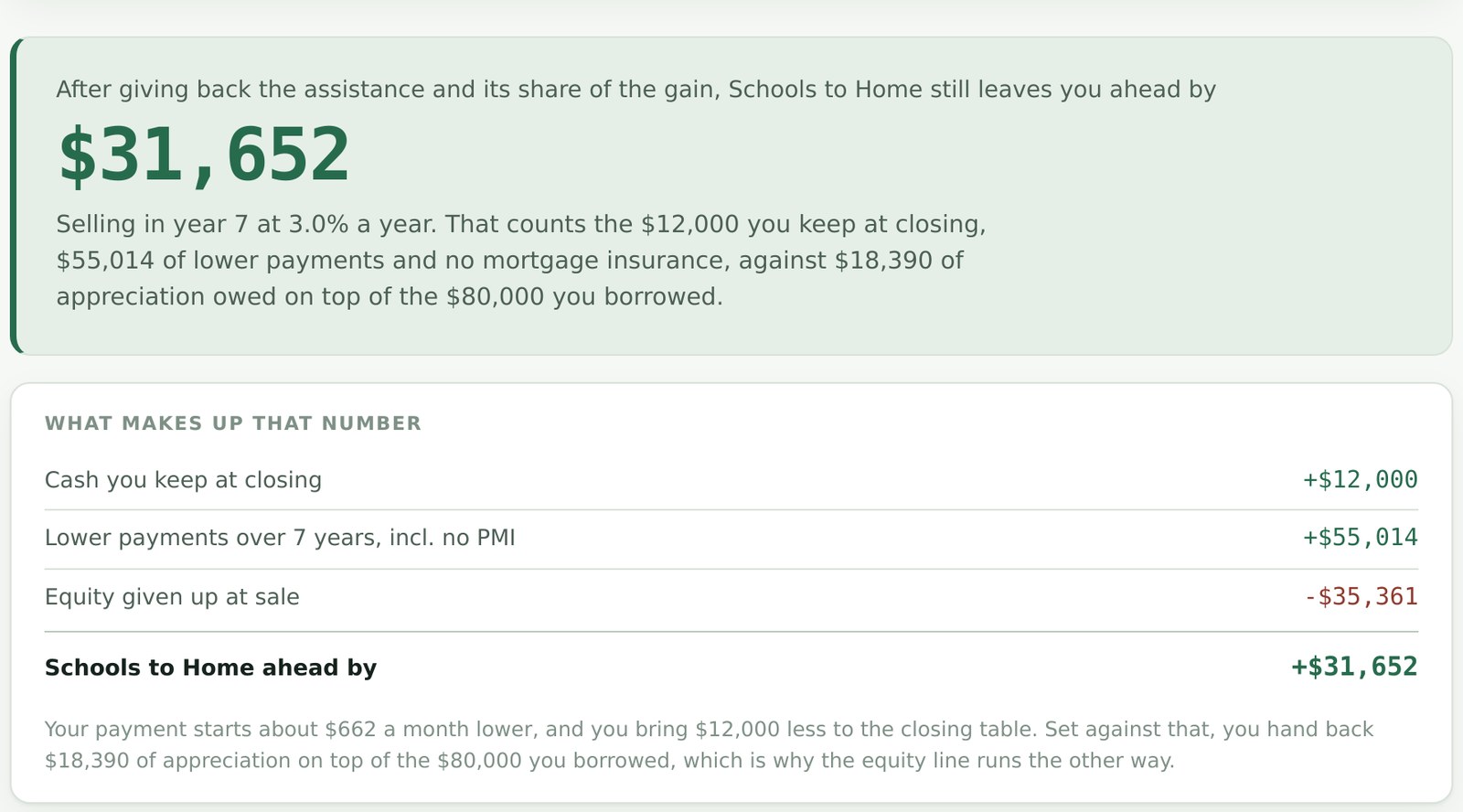
On a $400,000 purchase the first mortgage is $320,000 and the state second is $80,000, so the share is 20%. Sell seven years later at $491,950 and the gain is $91,950 — you repay the $80,000 plus $18,390 of appreciation. Against a conventional 3% down loan, which costs you $12,000 at closing and carries mortgage insurance until year 12, Schools to Home still leaves you roughly $31,652 ahead in that scenario — $12,000 you never put down, $55,014 of lower payments over seven years, less the $35,361 of equity the appreciation share costs you. A home that loses value owes no appreciation share, but the second is still repaid in full.
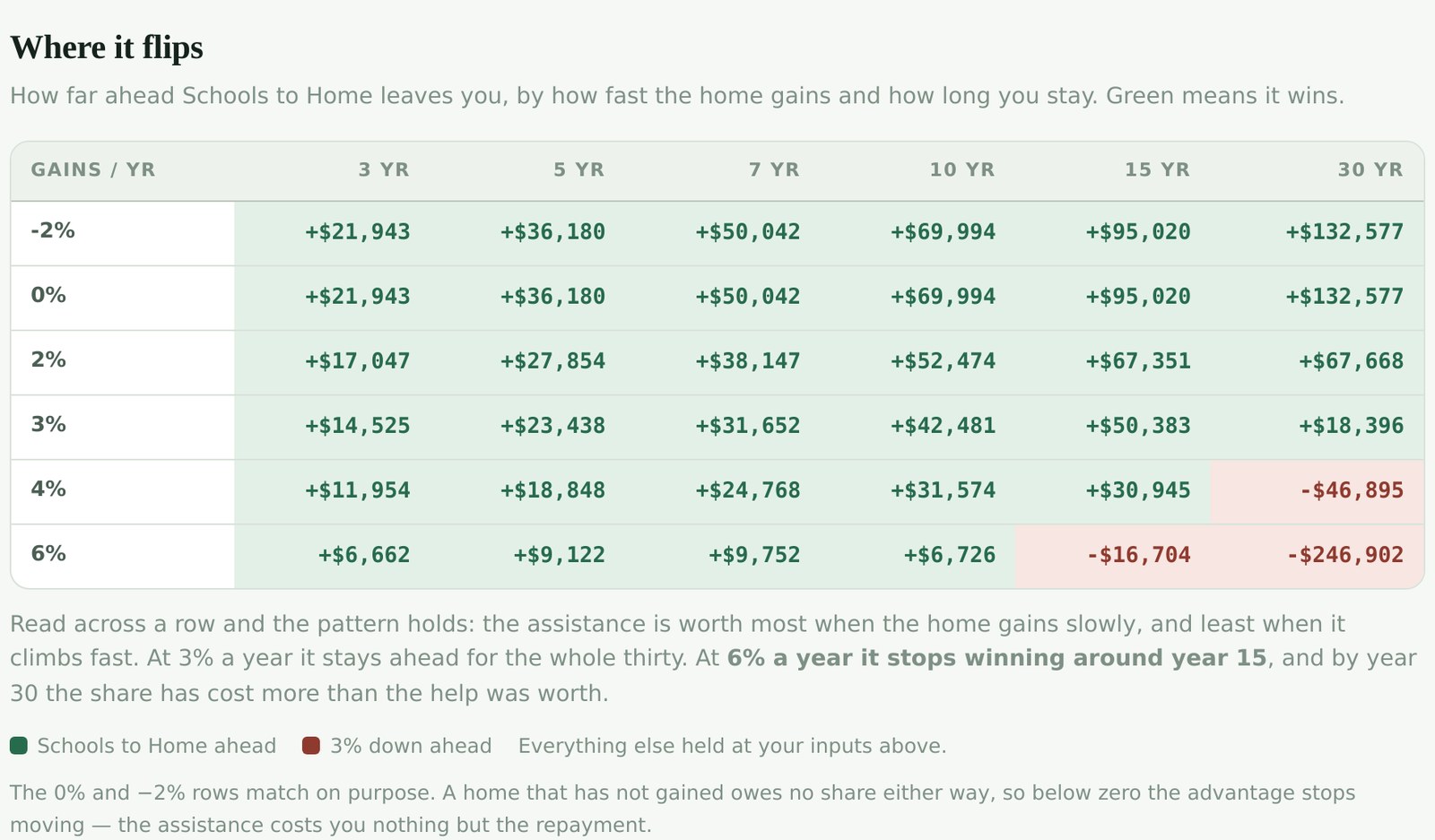
The balance shifts with how fast the home gains and how long you stay. At 3% a year the assistance stays ahead for the full thirty years; at 6% a year it stops winning between years 10 and 15. Put your own price, rate and timeline in below.
What the down payment help really costs you
Colorado pays your down payment and you skip mortgage insurance entirely — in exchange for a fixed slice of every dollar your home gains. Here is the trade, in your numbers.
Your situation
Change anything — everything below updates as you type.
After giving back the assistance and its share of the gain, Schools to Home still leaves you ahead by
Selling in year 7 at 3.0% a year. That counts the $12,000 you keep at closing, $55,014 of lower payments and no mortgage insurance, against $18,390 of appreciation owed on top of the $80,000 you borrowed.
What makes up that number
- Cash you keep at closing
- +$12,000
- Lower payments over 7 years, incl. no PMI
- +$55,014
- Equity given up at sale
- -$35,361
- Schools to Home ahead by
- +$31,652
Your payment starts about $662 a month lower, and you bring $12,000 less to the closing table. Set against that, you hand back $18,390 of appreciation on top of the $80,000 you borrowed, which is why the equity line runs the other way.
Priced at 6.625% on Schools to Home and 6.875% on the 3% down loan — a 97% loan-to-value loan prices above an 80% one — with PMI at 0.50% a year. These are illustrative, not quotes. Change any of them above and every figure on this page moves with it.
Schools to Home Ahead
80% first mortgage, no mortgage insurance, state second covers the rest.
- Cash at closing
- $0
- Monthly payment
- $2,399
- Mortgage insurance
- none
- Your appreciation share
- Equity when you sell
- $103,629
Conventional 3% down Behind
You fund the down payment and carry PMI until you reach 80%.
- Cash at closing
- $12,000
- Monthly payment
- $3,061
- PMI, drops off
- $162/mo, gone year 12
- Your appreciation share
- none — you keep it all
- Equity when you sell
- $138,990
Where it flips
How far ahead Schools to Home leaves you, by how fast the home gains and how long you stay. Green means it wins.
Read across a row and the pattern holds: the assistance is worth most when the home gains slowly, and least when it climbs fast. At 3% a year it stays ahead for the whole thirty. At 6% a year it stops winning around year 15, and by year 30 the share has cost more than the help was worth.
The 0% and −2% rows match on purpose. A home that has not gained owes no share either way, so below zero the advantage stops moving — the assistance costs you nothing but the repayment.
How the share is figured
CHFA sets your share once, at closing, and it never changes.
- You buy at $400,000. The first mortgage is 80% of that, $320,000 — the reason there is no mortgage insurance.
- The state second is $80,000. That is 25.0% of the first mortgage, and 20.0% of the purchase price.
- Your share is that second divided by the price: 20.0%. It is locked at closing and never moves.
- Sell in year 7 for $491,950 and the gain is $91,950.
- You owe the $80,000 back, plus 20.0% of that gain — $18,390. Total $98,390.
- Nothing is due until you sell, refinance, pay off the first, or stop living there.
What this assumes
- The first mortgage is 80% of the purchase price, which is what keeps mortgage insurance off the loan. The state second covers up to 25% of that first mortgage — 20% of the price. Take less and you bring the difference in cash.
- Your appreciation share is the original second divided by the original purchase price, applied to the gain between your purchase price and your sale price. A home that loses value owes no share, but the second is still repaid in full.
- Both loans are 30-year fixed and amortized properly, so the payoff figures sit slightly below CHFA's own illustration, which uses the opening balance.
- PMI on the 3%-down loan is removed once the balance amortizes down to 80% of the purchase price. That is the automatic rule. If the home climbs quickly you could cancel earlier by paying for an appraisal, which would narrow the gap — so this assumption leans slightly in Schools to Home’s favor.
- Taxes, insurance and HOA are identical in both columns, so they change the payment but never the comparison.
- Rates and mortgage insurance are assumptions, not quotes: 6.625% on the Schools to Home first mortgage, 6.875% on the conventional 3% down loan, and PMI at 0.50% of the loan balance per year. A 97% loan-to-value loan carries pricing adjustments an 80% loan does not, which is why the two rates differ. Your own quote depends on credit score, loan amount, property and the day you lock.
- Cash you keep at closing and each month of payment difference are counted at face value — no investment return, no tax effects.
- Selling costs are left out. They are the same either way.
Estimate only, not a commitment to lend or a quote. Rates, mortgage insurance and program terms change. CHFA sets Schools to Home terms — including income limits, a 620 minimum credit score, full-time employment at an eligible Colorado public school employer, and two required education courses — and verifies eligibility at application. Speak Straight Mortgage · Company NMLS 2426226 · Equal Housing Opportunity.
Prefer it on its own page? Open the Schools to Home estimator.
Keep reading
See if your school qualifies
Answer a few quick questions about your situation — no hard credit pull, no pressure. We'll confirm your eligibility for CHFA Schools to Home and map out your options.
Check my eligibility